How many satellites does Jupiter have? I don't know, but it's a
hell of a lot! Our Nature satellite
paper
discusses some of them. In
the mean time have a look at
this.
How many satellites does Jupiter have? I don't know, but it's a
hell of a lot! Our Nature satellite
paper
discusses some of them. In
the mean time have a look at
this.
We also wrote a review for the forthcoming book
JUPITER 2 about the satellites and the related temporary
satellites and Trojans of Jupiter.
If the nuclei of comets are fragments of Kuiper Belt Objects, then
should not the two types of object look basically the same? To examine
this question, I obtained two samples of the colors of nuclei and
KBOs and carefully compared them. The result is
here
and also
here.
Likewise, what about the shapes? Collisionally produced fragments
have well determined shape distributions. Are they the same as the
shapes of the cometary nuclei? Take a look
here
or see the paper
here.
We have examined the rotational properties of the large Kuiper Belt
Object (20000) Varuna using precision photometry from Mauna Kea.
We find a body that is elongated by its own rotation and infer a
bulk density 1000 kg/m3 (the density of water). This leads us to
suspect that Varuna is internally porous at the 15 - 25 % level.
See
here
We have analyzed the claim that the colors of Kuiper Belt Objects
are bimodally distributed and find no evidence to support it. Our
new work is based largely on careful color measurements from the
Keck 10-m telescope, and includes a sample of 28 objects. For the
first time, we performed statistical tests of the bimodal hypothesis,
with utterly negative results. The work can be found
here.
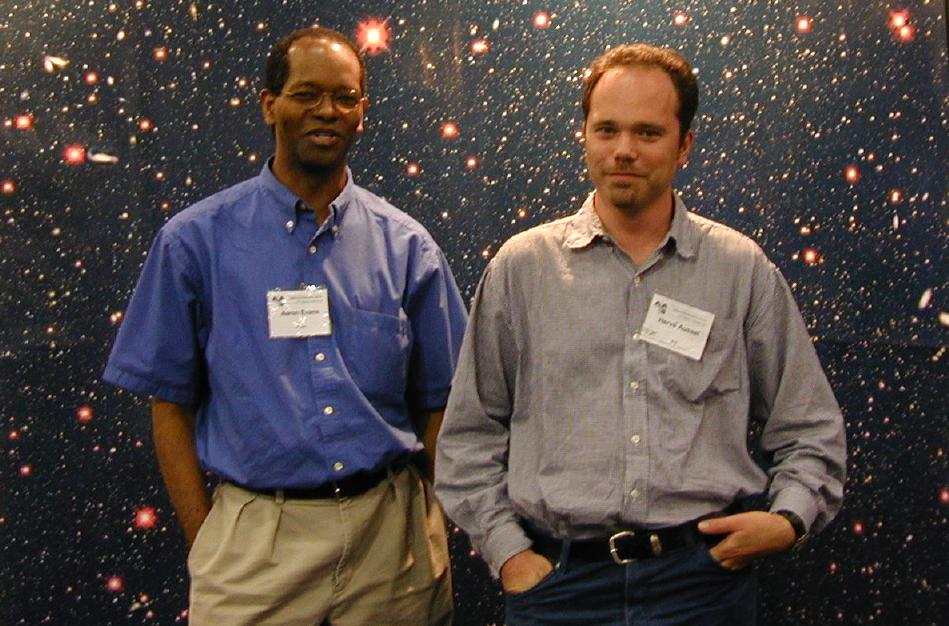
Measurement of the heat emitted by Kuiper Belt Object (20000) Varuna allowed
us to separately measure the albedo and the size of this object. This
was done in collaboration with JCMT Fellow
Herve Aussel and
Aaron Evans of Stony Brook. Here they
are posing against a fake star background.
The resulting paper is described and linked
here.
A comprehensive study of the trans-Neptunian Kuiper Belt.
The KB holds significance both as a visible remnant of the
protoplanetary disk, and as the likely source of the short-period
comets. Outstanding questions concern its size, population,
post-formation evolution and dynamical stability. Significant
findings to date include the discovery of the KB, the
realization that about 30% of the
trans-Neptunian objects exist
in dynamical resonance with Neptune (as does Pluto), and the
identification of the first Scattered KBO, an apparently separate
class of trans-Neptunian object. Work with
Jane Luu (Leiden University) and
Chad Trujillo, (Caltech).
We use the CFHT for this work.
The astrometry of newly found KBOs is a major effort, but vital if these
objects are not to be lost. Recently, IfA graduate student
Scott Sheppard has taken the lead
on object recovery and astrometry, mostly using the UH 2.2-m.
A near infrared program to measure the reflectance
properties of primitive objects. A recent result includes the
detection of water ice on Centaur 2060
Chiron.
We think that water ice was not previously recorded on this object because
of its bright coma. Now that the coma is fading, the bare nucleus is more
visible than in the past.
A wide field survey of the ecliptic intended to locate bright
but rare Kuiper Belt Objects and Centaurs. We used a wide
field
Automatic Patrol Telescope (a modified Baker-Nunn) in Australia.
This survey was a collaboration involving
Scott Sheppard,
Chad Trujillo,
Michael Brown and
Michael Ashley. And no, no
kangaroos were harmed during the conduct of this survey.
A study of the Trojans of Jupiter.
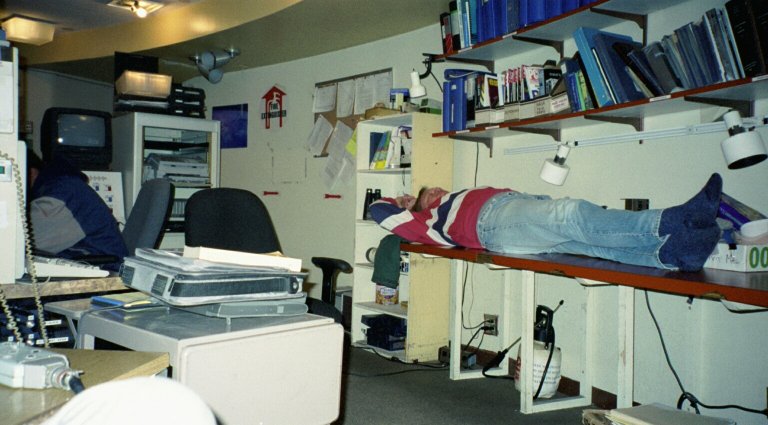
This search was based on the use of the UH 8192x8192 pixel CCD camera. We took a series of short
integration in long strips, aided by famed telescope operator John Dvorak and sometimes by assorted other people. We found that there must be about
150,000 Trojans larger than 1 km, with a size distribution that
steepens from q = -3 to q = -5.5 at large objects and we wrote a paper
about it
here. We think the small Trojans are collisionally produced fragments
of the bigger ones.
A coronagraphic study of nearby stars directed towards
understanding the Beta Pictoris phenomenon (with former graduate student
Paul Kalas, now at UC Berkeley).
see here
Spectroscopic investigation of comets with the fabulous JCMT.
Recently, we used the JCMT to measure the isotopic ratios of
Carbon, Nitrogen and Sulphur in comet Hale-Bopp. We found
ratios that are consistent with canonical "solar system" values,
compatible with an origin for Hale-Bopp as part of the solar
nebula. We would have been surprised by any other result but
it is nevertheless gratifying to have taken the measurements that
confirm our expectations. Have a
look.
In a project spearheaded by
the legendary Roland Meier and with
Henry Matthews
and
Toby Owen as collaborators, I have studied the
deuterium/hydrogen ratio in Hale-Bopp, again using JCMT. It is
known that D/H is affected by time-dependent and environment-dependent
chemical processes. Therefore, it provides valuable constraints on
the source of cometary volatiles.
With IfA postdoc
Yan Fernandez, I am measuring thermal
emission from primitive bodies to measure their albedos. It turns
out that many primitive bodies are extremely dark - albedos of
just a few percent - perhaps because their surfaces have been
carbonized by prolonged exposure to cosmic rays. We want to know
if all bodies are uniformly "cooked", or whether careful observations
might discern evolutionary trends.
Investigation of the nature and cause of activity in
distant comets. The major result is the identification of
CO as the activity-driver in comets which are too distant (and
therefore too cold) for water ice to sublimate. For example,
we recently used JCMT to show that CO produces the bright coma of
comet P/Schwassmann-Wachmann 1 (with former graduate student
Matt Senay).
Even more recently, we found that the extreme brightness of comet
Hale-Bopp at 7 AU is a result of CO outgassing from its nucleus
at about 1 tonne/sec (with
Henry Matthews, Joint Astron. Centre).
An intensive program of physical observations has been underway at
JCMT to take advantage of the recent bright comets Hyakutake and
Hale-Bopp. (see
Submillimeter Page
).
 Jewitt