ESS 109C Isotope Geochemistry Notes
May 16, 2007
Oxygen and hydrogen isotope geochemistry
- Class
notes & homeworks are available online –
http://www2.ess.ucla.edu/~schauble/Isotope_geochemistry/
- Oxygen and hydrogen isotope paleohydrology/paleoclimatology
- Earth’s hydrological cycle close to Rayleigh distillation
i. Most water vapor forms by evaporation of near-tropical ocean water.
ii. Little post-evaporation exchange between vapor and ocean
iii. Condensed water quickly removed as precipitation, or re-evaporated.
iv. dD
strongly correlates with d18O,
but varies more strongly (a further
from 1).
dD ≈ 7.96 x d18O + 8.9
v. Main control on amount of vapor remaining is temperature
1.
Equator – pole gradients
d18O(annual ave) ≈
0.7*T(annual ave) – 13.6
2. Elevation gradients (rain shadow)
vi. Glacial/interglacial variation
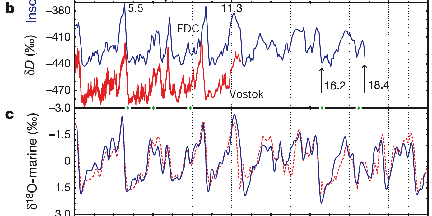

(Fig. From EPICA report (Antarctica
drill core) Nature, 2004
- What does ancient variation in dD or d18O in an ice core tell us?
- Assuming
no change in meteoric water line,
1‰ decrease in d18O ≈ ~-1/0.7 = –1.5ºC annual average T
1‰ decrease in dD ≈ –1/(0.7*7.96) = –0.18ºC annual average T
Actual correlation not so simple (e.g., changes in local weather patterns/sources of water vapor) - Measuring d18O & dD of water
- Water is not well suited for mass-spectrometry – low vapor pressure, adsorption, interference of H/D and 16O/17O
- d18O usually measured as CO2. H2O and CO2 will equilibrate oxygen with water in ~hours. H2O(l) vs. CO2(g) fractionation is well known (aCO2-H2Ol ≈ 1.0412 at room temperature). Equilibrated CO2 is easily separated by cold trap condensation of water.
- dD usually measured as H2. Water must be reacted with a metal at high temperature, scavenging oxygen. Reaction must be quantitative to avoid perturbing dD of analyzed H2.
- Typical precisions: d18O ±0.2‰, dD ±2‰ (can do much better under ideal circumstances). Why is dD harder to measure accurately?
- Carbonate d18O paleothermometry
- Ice is only accumulating in a few cold places (Poles, high elevations), and the oldest datable ice is < 106 years old. Ideally we’d like to be able to reconstruct climate globally, and oceanographic conditions over geologic time.
- Formation of calcium carbonate (CaCO3, either calcite or aragonite) by organisms is ubiquitous in the ocean. Soil and shell carbonate is also common on land.
- Equilibrium
isotope fractionation is temperature dependent!
H218O + 1/3•CaC16O3 ßà H216O + 1/3•CaC18O3
1000ln(aCalcite–H2O(l)) ≈ 2.78x10⁶/T2 –2.89 (O’Neil et al., 1969) T in Kelvin!
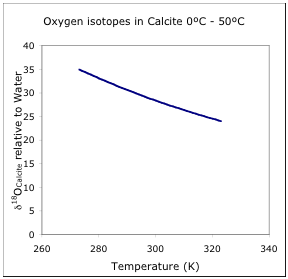
Then, if the d18O of the water is known (i.e., modern ocean water), and the d18O of a carbonate can be measured, the temperature at which the carbonate formed can be calculated. - Assumptions for equilibrium isotope paleothermometry:
i. Isotopic fractionation occurs at equilibrium during the formation of the sample.
ii. The equilibrium fractionation factor is known.
iii. Isotopic compositions of the relevant species (H2O and calcite in this case) can be measured or inferred with sufficient precision.
iv. The sample has been closed to exchange since it formed.
- Applications to real-world samples
i. Biological calcite precipitation may not occur at equilibrium – “vital effects” must be controlled. Best data sets focus on a single species or group of organisms with known equilibrium/disequilibrium behavior.
ii. Determination of equilibrium isotope fractionation at low temperature is difficult experimentally. Best data come from very slow precipitation experiments, extrapolation from high temperature (where equilibration is fast enough to complete in a lab).
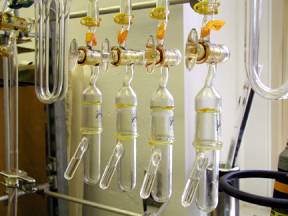
iii. d18O Calcite is easily measured using the McCrea technique
1. Sample is crushed
2.
Anhydrous H3PO4 is added in a vacuum at
controlled temperature.
H3PO4 + CaCO3 à ~CaHPO4 + H2O
+ CO2
1.
 Only
2/3 of oxygen goes to CO2!
Only
2/3 of oxygen goes to CO2!
à Must correct for acid-fractionation (~10‰)
3. CO2 is released, analysed on gas-source mass spectrometer
iv. Precipitating water is rarely preserved – generally must be inferred.
1. Does the d18O of the ocean vary?
2. Main source of uncertainty in T-reconstruction for glacial-interglacial transition, land-carbonates, Paleozoic & Precambrian carbonates.
v. Calcite will dissolve/exchange with warm fluids in metamorphic environments. Water is ~90% O by mass, so it is a potent reservoir for open-source exchange. Other minerals or organic materials may also exchange (usually at high temperature).
- d18O marine in EPICA data chart above is for oceanic carbonates. Does it match with the ice-core records?