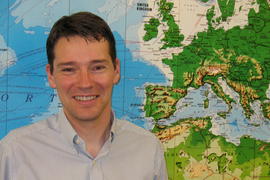
I am a professor affiliated with the Department of Earth, Planetary, and Space Sciences and with the Department of Physics and Astronomy at UCLA. With students and postdocs in a lively research group, I study the formation and evolution of planets with the tools of Astronomy, Geophysics, and Dynamics. You can use the navigation links on the banner above to learn more about my teaching and research interests.
Here is my CV and contact information.
I send sporadic updates to a twitter account about science, education, critical thinking, and policy.
News:
How realistic is the movie "Gravity"? (2013 Sep 28).
To prepare for an interview, I collected some thoughts about the realism of the science portrayed in "Gravity".
Radar Astronomy and the Asteroid Impact Hazard (2013 Apr 14).
Radar astronomy plays a critical role in assessing and mitigating the risk associated with asteroid impacts. My 4-minute presentation for the 2013 Planetary Defense Conference is available on youtube .
Planetary systems living on the edge of stability (2013 Feb 28).
A large fraction of planetary systems are full: if you throw one more planet into the mix, the whole thing goes unstable. For details, read our paper published in the Astrophysical Journal.
Characterization of potentially hazardous asteroid 2000 ET70 (2013 Jan 30).
The paper describes the results of our radar observations of a large near-Earth asteroid. Our measurements enable reliable trajectory predictions in the interval 460-2813, indicating that the asteroid poses no danger to Earth in the next 8 centuries.
Video of Astrobiology/SETI public talk available (2012 Dec 30).
A 14 minute video of my presentation at the Nov 15 UCLA-Mindshare event is now available on youtube.
Moments of inertia of the terrestrial planets: one down, one more to go (2012 Nov 5).
With bulk density, the moment of inertia is the most important quantity needed to understand the composition and interior structure of a planet. Our paper provides the moment of inertia of Mercury by combining 10 years of spin state observations and MESSENGER gravity data. Values for Mercury, Earth, and Mars are now know. The value for Venus has never been measured, but we are working on it.
Six years at eight planets (2012 Aug 24).
Six years ago the Astronomical community defined what it takes to be a planet. Most people have easily adjusted.
What is the architecture of planetary systems? (2012 Jul 24).
We studied the properties of planetary systems discovered around 1,790 stars and figured out how many planets there are and how inclined their orbits are. It turns out that our solar system is quite consistent with the majority of planetary systems out there. Our findings have been published in the Astrophysical Journal.
Large scale study of the effect of sunlight on asteroid orbits (2012 Apr 26).
We have identified and quantified changes in the orbits of 54 Near-Earth Asteroids due to the effect of sunlight. Understanding this effect is important as it represents the biggest source of uncertainty in trajectory predictions of potentially hazardous asteroids. Our paper in the Astronomical Journal is available here.
Predictions of additional planets in multi-planet systems (2012 Mar 13).
At least 8 planetary systems discovered by the Kepler mission, and possibly many more, are likely to harbor additional, yet-to-be discovered planets. Our paper, Predicting Planets in Kepler Multi-Planet Systems, appeared in the Astrophysical Journal.
Observations of the Galilean satellites (2011 Oct 22).
We are measuring the spin states of Europa and Ganymede with the goals of quantifying tilts in spin axes and oscillations in spin rates. These measurements can inform us about the interior structures, geological processes, and astrobiological potential of these icy moons .
"Where is MESSENGER?" smart phone application released (2011 Apr 7).
To help my colleagues and I keep track of MESSENGER's position in its orbit around Mercury, I wrote a small application for smart phones.
MESSENGER in orbit! (2011 Mar 17).
Instruments aboard MESSENGER are returning a wealth of new data about the enigmatic planet Mercury. My role on the Science Team is to combine spacecraft and ground-based data (gravity, topography, dynamics) to characterize the interior of the planet.
A planetary taxonomy proposal (2009 Jun 9).
A special session at the 214th meeting of the American Astronomical Society in Pasadena, CA was devoted to "Planet Classification in the 21st Century". My presentation can be downloaded here.
First detection of the YORP effect (2007 Mar 07).
Radar and optical observations of asteroid (54509) YORP provided the first direct observational evidence that sunlight modifies the spin of asteroids.
Observations of asteroid 2000 BD19 at Arecibo Observatory (2006 Feb 25).
Successful observations at Arecibo Observatory provided precise range measurements to the asteroid 2000 BD19, which comes very close to the Sun (the closest approach distance is only 20 times the radius of the Sun). The asteroid's orbit is perturbed by general relativity and the non-spherical shape of the Sun.
Contact:
Dept. of Earth and Space Sciences
Dept. of Physics and Astronomy
University of California, Los Angeles
595 Charles Young Drive East
5642 Geology Building
Los Angeles, CA 90095
310 206 8345
jlm@ess.ucla.edu